 Traderjoe
Traderjoe separates JOE fee sharing from liquidity provision
Traderjoe separates staking JOE for protocol fee sharing from supplying assets that earn trading fees in a liquidity pool. The exchange rebranded to LFJ in September 2024. Its Avalanche sJOE product accepts JOE and pays rewards in USDC, with your allocation determined by your share of the staking pool. Liquidity provision puts the selected pool assets into market-making contracts, so trading can change the tokens that your position holds. Staking keeps your principal exposed to JOE's price; liquidity provision adds inventory changes and, for Liquidity Book, range management. The choice starts with the assets you intend to hold and the work you're prepared to do.
Keeping JOE Exposure While Receiving Fee Income
An existing JOE holding can earn protocol fee-sharing income through Avalanche's sJOE staking product. The deposit records a JOE stake without creating a position in a trading pair. Avalanche sJOE distributes its fee-sharing rewards in USDC. Your share follows the credited JOE that you hold in the staking pool relative to its total credited stake. Additional deposits by other participants can reduce that share, even when your own JOE balance stays unchanged. sJOE has no staking lock-up that forces the deposit to remain for a fixed term.
Staking doesn't require choosing price bins or maintaining a token-pair allocation. Its income still changes with the protocol fees available for distribution. Holding JOE without staking avoids this contract exposure and earns no sJOE rewards.
The Fee Streams Behind Staking and Pool Returns
Protocol Fee Sharing
The staking pool receives the protocol portion of eligible trading fees, which differs from the income allocated to liquidity providers. Liquidity Book stores a configurable protocol share for each pool, expressed as a fraction of collected swap fees. A pool's trading fee and its protocol share therefore describe different quantities.
Higher volume can increase fee collection, while fee settings and competing stakes affect the amount allocated to each staker. An annualized staking rate projects income relative to the stake's value; it doesn't promise a fixed quantity of USDC.
Pool Fees and Incentive Rewards
Joe V1 charges a swap fee of 0.3% of the input amount. Liquidity Book combines a base fee with a variable component that responds to volatility. A provider's earnings depend on the swaps using their liquidity and the provider portion of those fees.
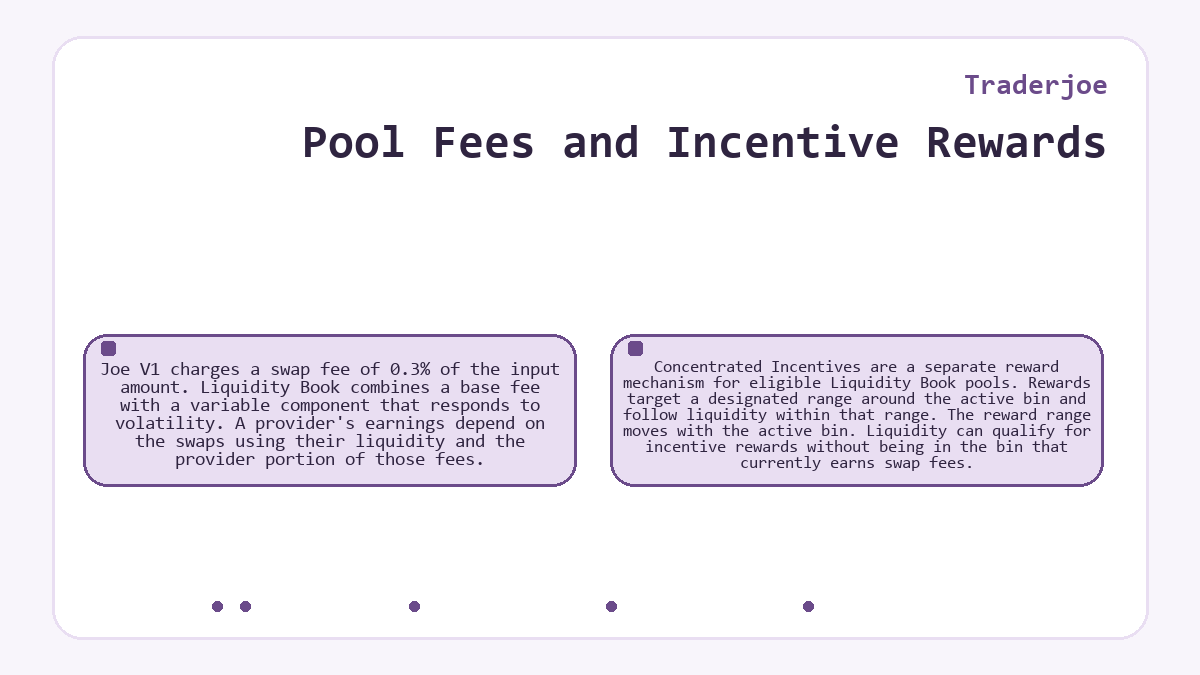
Concentrated Incentives are a separate reward mechanism for eligible Liquidity Book pools. Rewards target a designated range around the active bin and follow liquidity within that range. The reward range moves with the active bin. Liquidity can qualify for incentive rewards without being in the bin that currently earns swap fees.
V1 Pools and Liquidity Book Positions
Full-Range V1 Liquidity
A V1 position supplies liquidity across the full price range, avoiding a choice of price bins. Deposits follow the pool's reserve ratio, pairing tokens at equal value using its quoted price. Equal value doesn't mean equal token quantities. This is a different commitment from depositing only JOE into sJOE.
A V1 LP token represents a proportional claim on the pool's reserves. Swaps change those reserves, so withdrawing liquidity returns the position's share of the current token balances. The deposit doesn't reserve the original quantities for later withdrawal. That changing composition affects the outcome even while trading fees accumulate.
Liquidity Book Price Ranges
Liquidity Book lets providers distribute assets across selected price bins. Liquidity Book allocates swap fees to the liquidity in the bins that a trade uses. A position outside the trading range earns no swap fees until trading reaches its bins again or its liquidity is repositioned. Wider distributions cover more price points, while narrower ones concentrate capital around fewer prices.
Moving liquidity closer to the active price can restore participation in trading. It also changes the position's market exposure and incurs transaction costs. Rebalancing itself doesn't recover losses already reflected in the position's value. The relevant comparison with sJOE is the work of managing that inventory, alongside the potential income from serving trades.
Price Exposure and Position Management
JOE staking retains JOE price exposure, even though rewards arrive in a stablecoin. Liquidity provision exposes capital to the pool assets and changes their quantities through trading. Impermanent loss is the inventory-related shortfall against holding the same starting assets outside the pool. Fees can offset that difference, but they don't automatically do so. Concentrating liquidity can intensify inventory changes over a selected range. Both routes also expose deposited assets to their respective smart contracts.
Measuring Earnings Without Counting Deposits Twice
sJOE accounting separates credited JOE principal from pending and claimed USDC rewards. Additional JOE deposits increase principal; they aren't earnings. Claimed USDC moves income into the wallet without turning it into a larger JOE stake. To assess total return, value the remaining stake and rewards in a consistent currency, then account for deposits, withdrawals, and transaction costs. The contract supports a configurable deposit fee. If that setting is nonzero, the credited JOE is less than the amount transferred. That deduction belongs among entry costs.
Pool accounting needs the current asset quantities, alongside any income held separately. V1 trading fees accumulate inside the pool's reserves. Adding an estimate of those same fees to the position's reserve value counts income twice. In Liquidity Book V2.2, provider fees remain within the relevant bin's reserves after the protocol portion is removed. Separately claimed incentive tokens require their own accounting.
The holding benchmark answers another question: how would the original asset quantities be valued at the same closing prices? Comparing that value with the liquidity position helps distinguish inventory effects from a general market rise. Additional deposits and partial withdrawals need matching treatment in both totals. A larger withdrawal value alone doesn't establish that providing liquidity outperformed holding.
Choosing Between a JOE Stake and Pool Inventory
The choice starts with whether you want to retain JOE principal or accept the changing inventory of a liquidity position. Staking and liquidity provision receive trading income through different claims.
- If retaining JOE principal is the aim, sJOE adds protocol fee sharing without selecting a trading pair.
- If supplying a token pair across the price range is the aim, V1 removes the need to select bins.
- If concentrating capital around selected prices is the aim, Liquidity Book requires monitoring the position's trading range.
- For an incentivized Liquidity Book pool, distinguish the reward range from the bins earning swap fees.
- Before comparing costs, include network transactions and any active deposit fee; sJOE's deposit fee is configurable.
Avalanche sJOE's USDC rewards remain separate from its credited JOE principal. A stablecoin payout doesn't make the stake itself a stablecoin holding.
Traderjoe: quick answers
Do I Receive an sJOE Token When I Stake JOE?
The sJOE staking product doesn't issue a receipt token for deposited JOE. The contract records your stake against your wallet address. An absent sJOE token in the wallet therefore doesn't establish that the deposit failed; the relevant balance is the recorded staking position.
Why Did My Pending USDC Drop After Adding More JOE?
Adding JOE to an existing sJOE stake automatically claims pending rewards into your wallet. The pending figure can fall because that income has moved out of the staking contract. Review the USDC transfer associated with the top-up before treating the change as lost earnings.
Can a Legacy Arbitrum sJOE Position Receive New Deposits?
The legacy Arbitrum sJOE pool is withdrawal-only. Its restriction applies to that deployment, so an existing balance there shouldn't be treated as an active opportunity to add JOE. Avalanche staking has a separate contract; sharing a product name doesn't make the deployments interchangeable.
Must I Hold JOE to Provide Liquidity in an LFJ Pool?
Liquidity provision requires the assets of the selected pool, so JOE is needed only when that position requires JOE. A V1 deposit follows the pair's reserve proportions. Liquidity Book requirements also depend on the selected bins and distribution. Protocol-token staking is a separate use of JOE.
Are V1 Trading Fees Still Accruing While LP Tokens Sit in a Farm?
Depositing V1 LP tokens into a farm preserves the underlying claim on pool reserves and their trading fees. Farm incentives are separate income. A farm that stops distributing rewards doesn't, by that fact alone, stop the underlying pool from earning fees when swaps continue.
Does Withdrawing JOE Also Claim sJOE Rewards?
The standard sJOE withdrawal function harvests pending rewards while returning the requested JOE principal. Principal and rewards remain different parts of the return even when one transaction transfers both. Returning deposited JOE shouldn't be counted as fee income.
Will Sending JOE Directly to the Staking Contract Create a Stake?
A direct token transfer doesn't create the recorded stake that the sJOE deposit function creates. Depositing through that function updates the account's staking balance and reward accounting. Sending JOE to a contract address bypasses those updates and can leave the tokens without a corresponding withdrawal claim.